
OPT Denied or Rejected? 11 Reasons and What to Do Next
OPT
OPT (Optional Practical Training) is employment training directly related to an F-1 student’s major area of study. Eligible students can apply for up to 12 months of employment authorization in below formats:
-
Pre-completion OPT: before completing academic studies
-
Post-completion OPT: after completing academic studies
However, all periods of Pre-completion OPT will be deducted from the available period of Post-completion OPT.
OPT Is a work permit granted by the U.S. government to international students to stay in the United States after graduation. It’s a 1-year work authorization, but STEM majors could get up to 3 years of OPT with STEM OPT extension.
What should I do if my OPT application got rejected?
What does OPT Rejection mean for international students?
It means that the student will lose their legal work status in the United States. If they fail to depart the US within the given time limit, they will become an illegal resident. This would render years of complex study and hard work in vain.
Many recently graduated students have received OPT EAD cards. However, we have also received numerous inquiries from students seeking help after their OPT applications got rejected.
Students who face OPT rejection are understandably concerned and may have questions, for instance:
-
"What should I do if I'm rejected?"
-
"Is there any possibility of appeal?"
-
"What other ways can I stay and work in the United States?”
Hopefully some of your questions can be answered after going through this page.
Typical Cases and Reasons for OPT Rejection
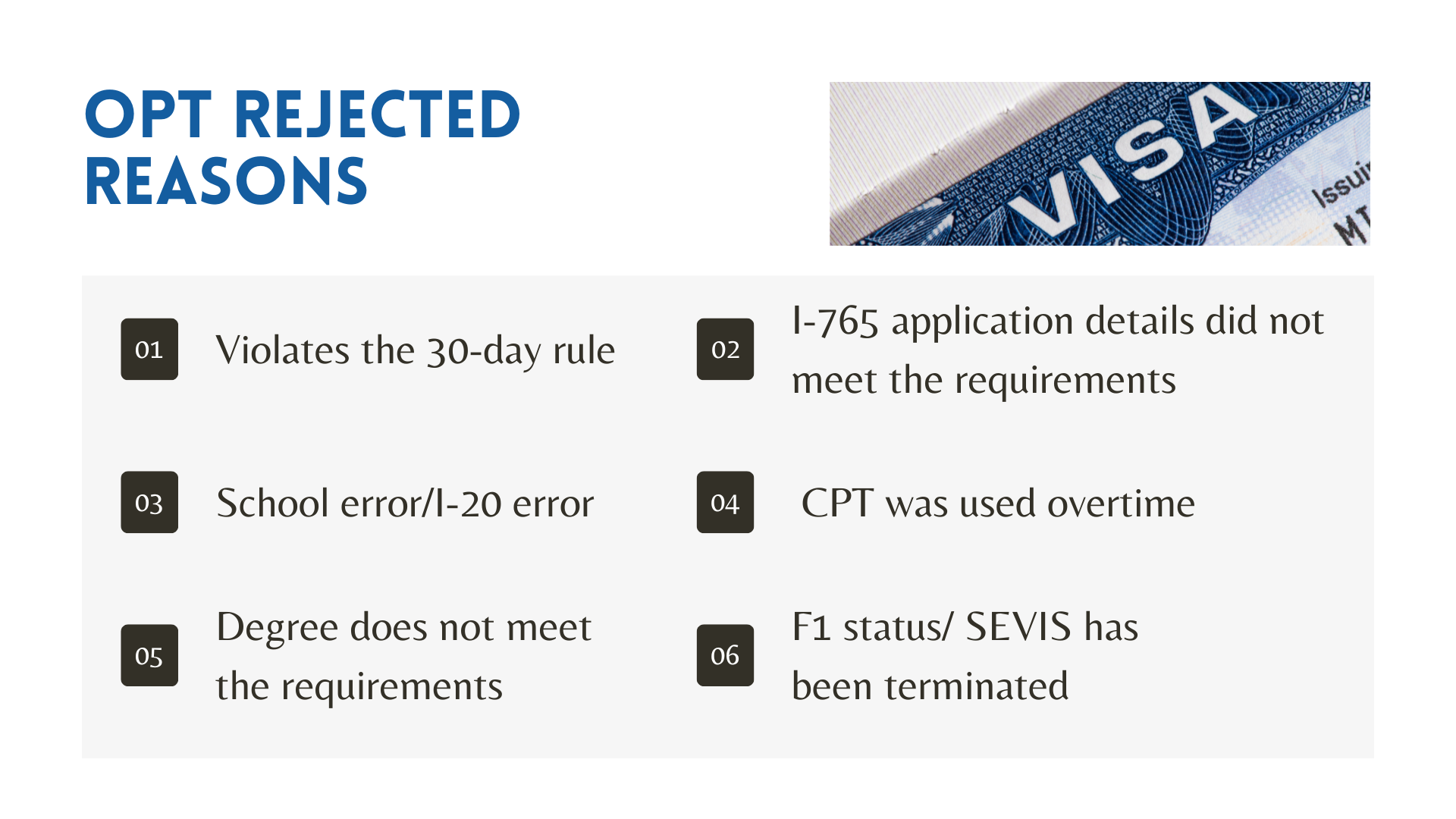
1. Late OPT application submission results in rejection
USCIS requires students applying for post-completion OPT to file Form I-765 within 30 days after their DSO enters the OPT recommendation in SEVIS. Students can file up to 90 days before their program end date, but no later than 60 days after it. Filing outside these deadlines can result in an OPT denial.
2. Inadequate I-765 materials lead to OPT rejection
Rejected OPT applications often result from incomplete or inaccurate application materials. This frequently occurs because students are unaware of the detailed application requirements. Common mistakes include submitting the incorrect check format, missing information on the I-765 form, forgetting to sign, providing incorrect information, and using the wrong OPT code.
3. School or I-20 errors can cause OPT rejection
When applying for OPT, students must first obtain an OPT recommendation I-20 from the DSO responsible for international student affairs and update their I-20 status in the system. During peak OPT filing periods, it is possible for the DSO to issue the wrong I-20 or forget to update the I-20 status, resulting in submitting the wrong OPT I-20 to USCIS, leading to its rejection. Students must review the documents thoroughly to avoid errors.
4. Full-time CPT for 12 months can lead to OPT rejection
Students who use 12 months or more of full-time CPT become ineligible for OPT at the same educational level. Part-time CPT does not affect OPT eligibility, even if used for 12 months or longer.
5. Applying with an ineligible degree results in OPT rejection
International students may generally receive up to 12 months of OPT at each education level. If a student has already used OPT at the master's level, completing another master's degree does not provide a new 12-month OPT period. However, completing a higher education level, such as a doctoral degree, may make the student eligible for another period of OPT.
6. F1 status or SEVIS termination can cause OPT rejection
To be eligible for OPT, students generally must complete one full academic year of lawful full-time study at an SEVP-certified school and be in valid F-1 status when applying. The full academic year does not necessarily need to be completed entirely in F-1 status; qualifying study in another valid nonimmigrant status may count. A new SEVIS number or school transfer does not automatically reset the one-academic-year requirement, so students with a transfer, reinstatement, or new SEVIS record should confirm their OPT eligibility with their DSO.
If a student's OPT application is denied, USCIS will send a written denial notice explaining the reason for the decision. An OPT denial ends the requested employment authorization, but its effect on the student's F-1 status depends on the timing and reason for the denial. Students should review the denial notice and contact their DSO promptly to understand their available options.
Differences between OPT Rejection & Denial
.png)
OPT Rejections
An OPT rejection occurs when USCIS does not accept your Form I-765 for processing because of a filing issue, such as an incorrect filing fee, missing signature, or unacceptable form edition. A rejection is different from an OPT denial, which happens after USCIS accepts the application and reviews your eligibility.
Potential reasons why:
-
USCIS payment failure: If the payment for your OPT or STEM OPT application fails or is declined, USCIS may reject the application for lack of payment. Make sure your payment information is correct and sufficient funds are available before filing.
-
Your form I-765 was not signed, rendering the application incomplete.
-
Several required documents are missing from your OPT application packet, which makes it incomplete and thus subject to rejection.
-
You did not provide a reason for applying, which is the very first question on the I-765 form, and as such, the application is incomplete.
-
Your I-765 application used an outdated version of the form, which is not acceptable for submission. We advise you to download the most recent version of the I-765 form directly from the USCIS website each time you apply to avoid such issues.
*Please note that USCIS does not process your payment for a rejection.
OPT Denial
An OPT denial occurs when USCIS accepts your Form I-765 for processing but later determines that the application cannot be approved. This may happen if you do not meet OPT eligibility requirements, miss a filing deadline, or fail to provide sufficient evidence.
Potential reasons why:
-
The OPT application packet was submitted to USCIS after the 30-day deadline, which is based on the date ISSS issued your I-20, rendering it invalid and subject to rejection.
-
OPT authorization has already been granted at the same degree level, as the U.S. government permits only one OPT authorization per degree level. As such, the application will not be processed and is subject to rejection.
-
It is apparent that you have not met your eligibility requirements, which include completing one academic year of full-time studies in the United States. The application, therefore, cannot be processed and will be rejected.
-
OPT was applied for after the 60-day grace period had expired, which is not within the allowed period, rendering the application ineligible and subject to rejection.
* If the OPT application is denied, USCIS will still process the payment made, even in the event of a rejection.

OPT Denied or Rejected: What Are My Options?
What If My STEM OPT Is Denied?
If your STEM OPT extension is denied, review the USCIS denial notice carefully and contact your DSO immediately. A new STEM OPT application must still meet the original filing deadlines. Students may file Form I-765 up to 90 days before their current OPT EAD expires, and the application must be filed within 60 days after the DSO enters the STEM OPT recommendation in SEVIS.
You may wonder what options are available to you to stay and legally work in the United States. Here are some solutions that you can consider:
-
Solution 1: Reapply for OPT
If your OPT application was rejected due to errors in the materials submitted, you may be able to correct the issue and reapply. However, the new application must still meet the original OPT filing deadlines. For post-completion OPT, Form I-765 must be filed within 30 days after the DSO enters the OPT recommendation in SEVIS and no later than 60 days after your program end date. Contact your International Student Office promptly before reapplying.
-
Solution 2: Submit a Motion to USCIS
If you believe your OPT application was incorrectly denied, you may be able to file Form I-290B to request a motion to reopen or reconsider. A motion to reopen is based on new facts or evidence, while a motion to reconsider argues that USCIS incorrectly applied the law or policy based on the existing record. In general, the motion must be filed within 30 days of the denial, so review your denial notice carefully before filing.
-
Solution 3: Apply to Other Schools to Restore Student Status (🔥Easiest and Safest Option)
Many students choose to apply to other schools to maintain their F1 student status if they cannot meet the requirements for a new OPT application or a motion.
Some universities offer full-time Curricular Practical Training (CPT) opportunities, which allow students to work and maintain their F1 visa status. You can learn more about Day-1 CPT Universities here. Students need to maintain a grade point average of 3.0 or above and follow all the regulations of the school. They also need to ensure that the CPT program and the school are legitimate and comply with immigration laws, schedule a consultation, let us help you find a legit program just for you:
Applying to another school does not automatically restore F-1 status or work authorization. If you are out of status, you may need to apply for F-1 reinstatement with USCIS or leave the United States and re-enter with a new Initial Form I-20, depending on your situation. Contact your DSO before transferring or enrolling in a new program.
-
Solution 4: Convert to Other Status or Visa Type
-
Spouse Visa: Married students may be able to change to F-2 or H-4 dependent status based on their spouse’s immigration status. F-2 dependents cannot work in the United States. Certain H-4 spouses may qualify for employment authorization if the H-1B spouse has an approved I-140 or qualifies for an H-1B extension under AC21.
-
Outstanding Talent Visa: Students with extraordinary ability may qualify for O-1 nonimmigrant status or, in some cases, the EB-1A immigrant classification. Eligibility is based on documented achievements and recognition in the applicant’s field; having a Ph.D. alone does not automatically qualify someone.
-
Multinational Company Expatriate Visa (L-1B Visa): Students working for a multinational company may qualify for L-1B status after working abroad for a qualifying parent, branch, subsidiary, or affiliate for at least one continuous year within the previous three years. The U.S. position must also require specialized knowledge of the company’s products, services, processes, or procedures.
-
Immigration: Students who meet the eligibility criteria can apply for immigration to obtain long-term legal status in the United States.
-
Have a Problem with Your Current OPT/F1 Status?
Think of a legit backup plan, so the most important, your legal status, won’t be jeopardized!
If you want us to help with Day-1 CPT universities based on your locations and needs, Fill out the form and rest assured!

)%20(6).png?width=101&height=101&name=%E8%83%8C%E6%99%AF%20(Canvas%20(Square))%20(6).png)